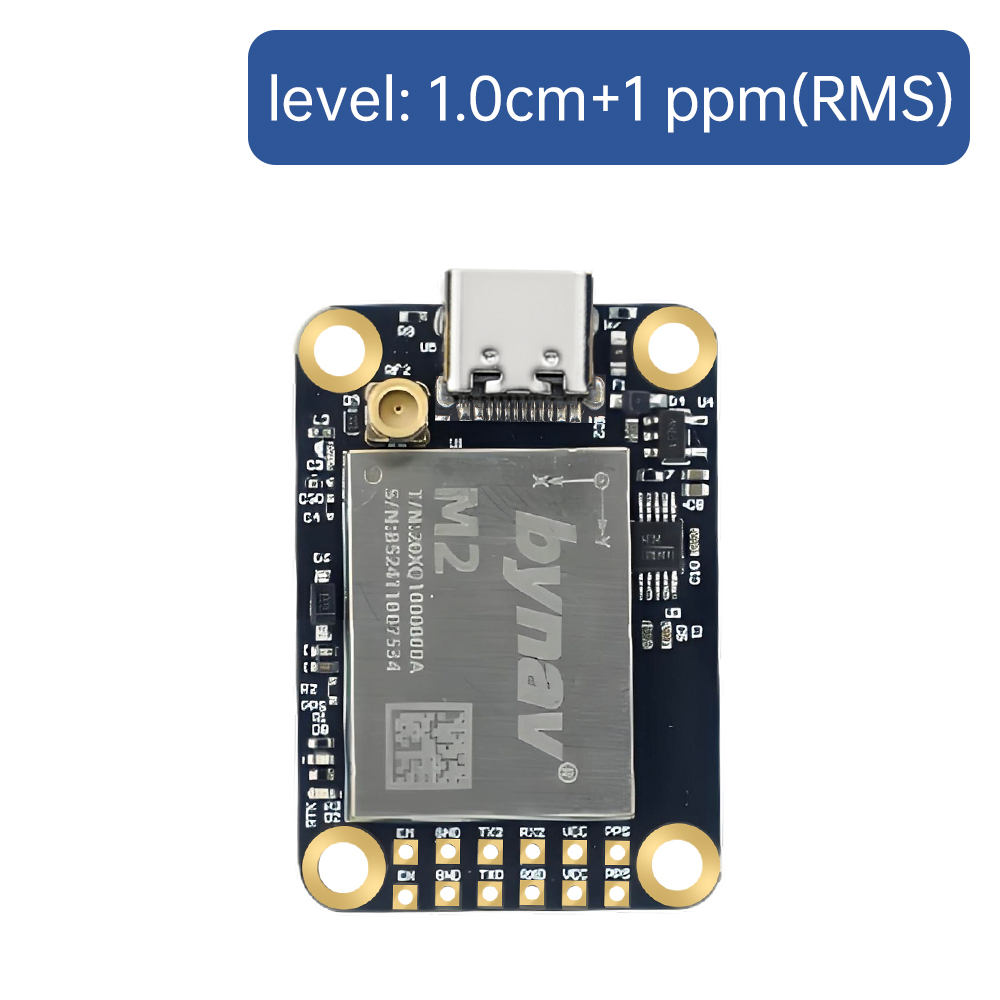
Overview
1. 22nm GNSS SoC chip Alice
2. Supports three-vector RTK (master-slave antenna positioning results + dual-antenna orientation)
3. Supports BDS-3 and B2b (PPP)*
4. High-performance anti-interference*
5. Supports Ethernet port, can embed SDK differential account, supports gPTP time synchronization
6. AB partition design, stable and reliable OTA upgrade
7. Supports system self-test and fault diagnosis*
8. Orientation baseline length range: 20cm to unlimited, standard is 1 meter
Specifications
| Indicator | Index |
| GNSS Band1 | BDS B1I, B2I, B1C*, B2b (PPP)* GPS L1 C/A, L1C*, L2 GLONASS G1, G2 Galileo E1, E5b QZSS L1C*, L2, L1 C/A |
| Number of Channels | 1500 |
| Re-acquisition Time | ≤1s |
| Measurement Accuracy | 10Hz |
| GNSS Observation Transfer Rate | 10Hz |
| Single Point Positioning Accuracy | Horizontal2, 3: 1.5m (RMS) Vertical2, 3: 2.5m (RMS) |
| RTK Accuracy | Horizontal2, 3: 1.0cm+1ppm (RMS) Vertical2, 3: 1.5cm+1ppm (RMS) |
| Heading Accuracy | 0.2°/1m baseline (RMS) |
| Timing Accuracy3 | ≤20ns (RMS) |
| Velocity Accuracy4 | 0.03m/s (RMS) |
| Initialization Time | Cold start: 30s 6 Hot start: 5s 7 |
| RTK Initialization Time2 | 5s (Typical value) |
| Anti-jamming* | 65dBc (signal-to-noise ratio) Multitone interference with 6 or more pulses. Narrowband interference whose bandwidth is not less than 10% of the signal bandwidth. Fast sweep interference. |
| L-Band | 10-5 (Error rate) |
| Power Consumption5 | 530mW |
| Weight | 1.75g (Typical value) |
| Size | 16.0x21.0x2.6mm (Typical value) |
* Support in special firmware.
Note 1: The signal of B1C, B2b, L1C, SBAS is supported in special firmware.
Note 2: Typical value.Performance will be affected by GNSS status,satellites’ location,baseline length,multipath and
other interference.
Note 3: -130dBm and more than 12 satellites are available.
Note 4: Open sky without any obstruction,99%@static.
Note 5: Typical value. Power consumption of antenna and peripherals is not included.
Note 6: Typical value. The duration from power-up to the first output of a valid single-point solution after clearing the
ephemeris/almanac/approximate position and time information.
Note 7: Typical value. The duration from power-up to the first output of a valid single-point solution, given that the
receiver has stored valid ephemeris/almanac/approximate position and reasonably accurate time (error less than 5
minutes). The special firmware can support 2s hot start, and the firmware can’t support network port.
Application


Download
Product InformationVideo